LLC can be taxed as what? This is one of the most common questions new business owners ask when forming a Limited Liability Company. The truth is, an LLC is one of the most flexible business structures when it comes to taxation. In this guide, we’ll explain all the tax classification options available for LLCs in the United States and help you choose the best one for your business.
What Is the Default Tax Status of an LLC?
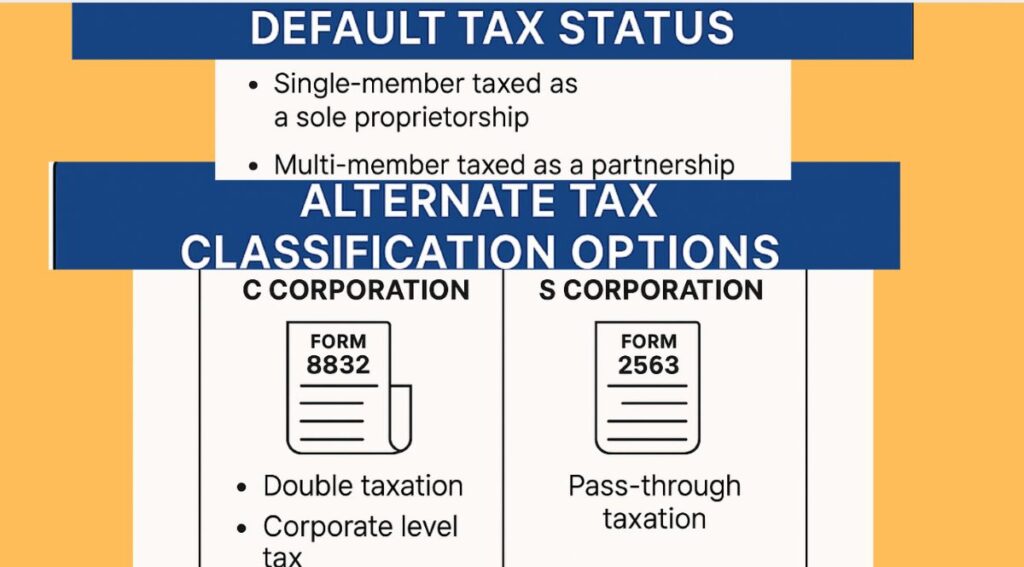
By default, the IRS does not assign a separate tax classification to an LLC. Instead, an LLC is taxed based on the number of its members:
- Single-member LLC: taxed as a sole proprietorship
- Multi-member LLC: taxed as a partnership
In both cases, the LLC itself does not pay income taxes. Instead, profits and losses “pass through” to the owners, who report them on their personal tax returns.
What Other Tax Options Can an LLC Choose?
An LLC can elect to be taxed as a corporation — either:
- A C Corporation (C-Corp)
- Or an S Corporation (S-Corp)
To do this, you must file specific forms with the IRS:
| Tax Type | IRS Form | Key Features |
|---|---|---|
| C-Corp | Form 8832 | Double taxation (corporate and personal level) but better for reinvestment |
| S-Corp | Form 2553 | Pass-through taxation + potential payroll tax savings |
Summary: LLC Can Be Taxed As What?
| LLC Type | Default Tax Status | Can Elect To Be Taxed As |
|---|---|---|
| Single-member | Sole Proprietorship | C-Corp or S-Corp |
| Multi-member | Partnership | C-Corp or S-Corp |
Which Tax Classification Is Best?
There’s no one-size-fits-all answer. It depends on:
- How much profit your business makes
- Whether you reinvest or distribute profits
- Your payroll setup
- Your personal income bracket
👉 S-Corp status can reduce self-employment taxes but requires running payroll
👉 C-Corp status is better for raising venture capital or long-term reinvestment
Final Thoughts
LLC can be taxed as what? The answer: your LLC can be taxed as a sole proprietorship, partnership, C-Corp, or S-Corp, depending on how you structure it. The flexibility is a major advantage of LLCs, but it’s crucial to choose the right status for your business goals
read more > click here